If you’ve searched for the Lunch Money app as a Canadian, you’ve found a good one: it’s a Toronto company, it bills in Canadian dollars, and it handles many currencies in one budget. Larch is a different kind of tool. Lunch Money is a flexible budgeting and tracking app with a bank connection, built for people who like to set things up their own way. Larch keeps the whole household’s money in one place: budgets and bills, net worth for both partners and each, contribution room, investments, your home and a rented suite or side business. It’s free while in beta. Every Lunch Money fact below comes from Lunch Money’s own pages, checked on Nov 18, 2026.
The short answer
- Choose Lunch Money if you want a bank connection that brings transactions in for you, money in several currencies in one budget, rules and tags you set up yourself, a developer API, and companion apps for iOS and Android.
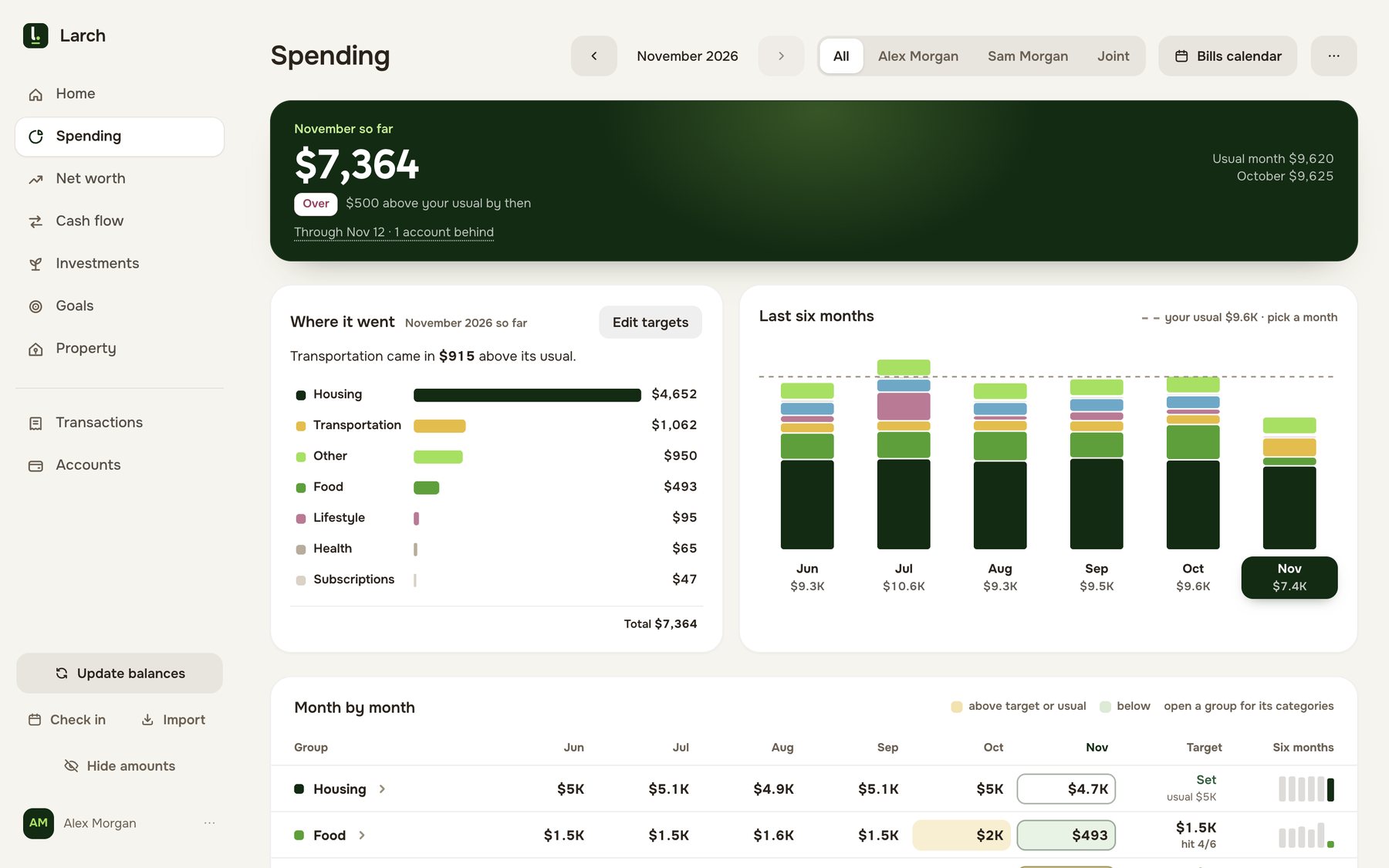
- Choose Larch if you’re a Canadian household that wants one picture of everything: what you spent, what you’re worth together and apart, how much TFSA, RRSP and FHSA room each of you has, what your home and mortgage are doing, and the books for a rented suite or side business. You bring a statement once a month; Larch never asks for your bank password.
What Lunch Money costs in Canada
Lunch Money’s Canada page says: “Plans are $10 CAD a month, or you can choose your own annual price from $60 to $150 CAD.” It also says “You pay in Canadian dollars, so exchange rates won’t change your subscription cost.” Its pricing page adds a price lock on the yearly plan and a 30-day trial with “No credit card”. Because these prices are already in Canadian dollars, there’s nothing to convert.
| Lunch Money | Larch | |
|---|---|---|
| Yearly | Pay what you want, $60 to $150 CAD | Free while in beta |
| Monthly | $10 CAD ($120 over a year) | Free while in beta |
| Trial | 30 days, no credit card | No trial needed; no card |
| People on one plan | The budget’s admin pays; collaborators join free, with no limit on how many | Your household: you and your partner, each with your own login |
Feature by feature
| Lunch Money | Larch | |
|---|---|---|
| How transactions get in | Bank connection through Plaid in Canada, the US and 17 European countries; CSV and PDF statement imports; typing them in | Statement files, CSV or PDF, from your banks and cards. Larch learns a new bank’s layout once |
| Your bank password | Linked through Plaid, which “works directly with your bank”; PDF statements are read by a partner, Bank Statement Converter | Never asked for |
| Budgeting | Flexible: “There’s no ‘right’ or ‘wrong’ way to budget”, with budget periods and rollovers | Category budgets and targets against your usual month, shown as “$446 of $350 · $96 over” |
| Bills | Recurring items for income and expenses, matched by payee, amount and date | A bills calendar of every bill, payday and card payment, marked paid, due or late, that you can add to Apple or Google Calendar |
| Where the month went | Reports, plus spending stats in the companion app | Income branching into spending, saving and investing, with what you kept and the rows behind each branch |
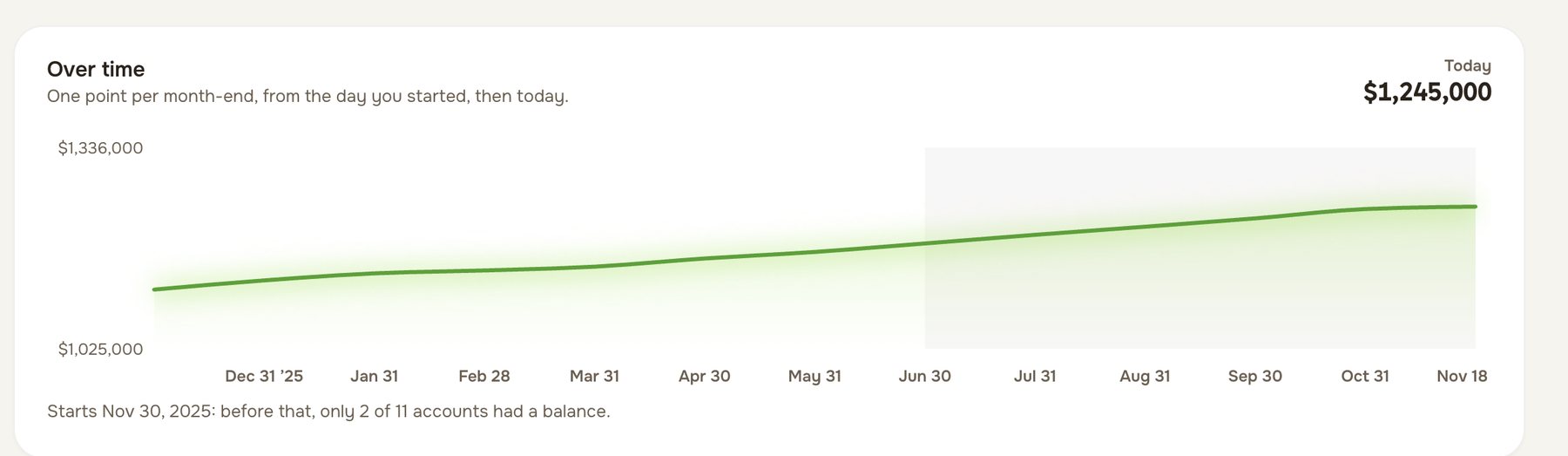
| Net worth | A month-end snapshot of every account’s balance | For the household or either of you, with an account-by-account, month-by-month table |
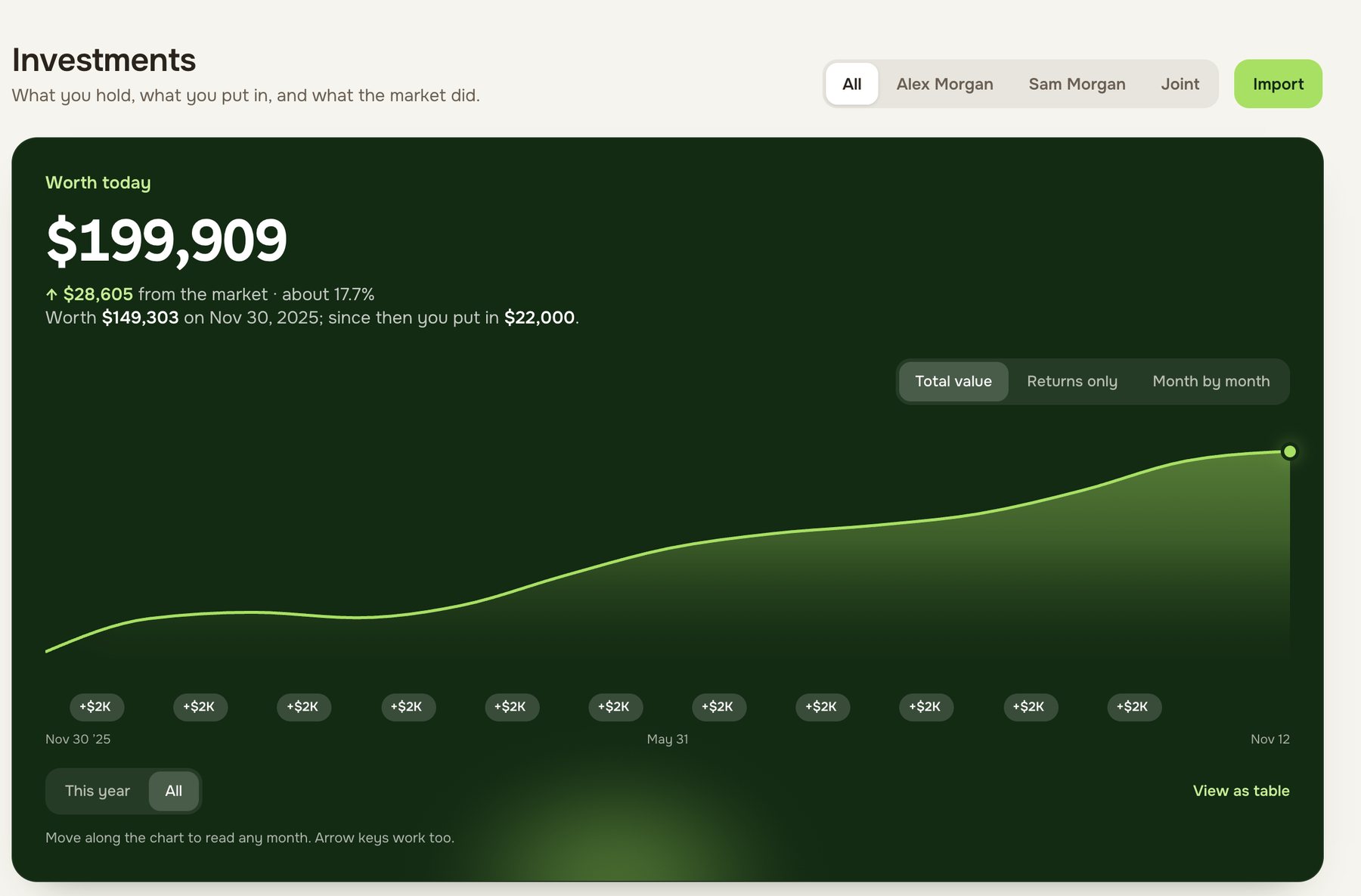
| Investments | Investment account balances through Plaid in Canada and the US, and a crypto tracker; investment transactions aren’t imported. Holdings by security: not stated | Holdings from your brokerage’s report, by security, with this year’s market change |
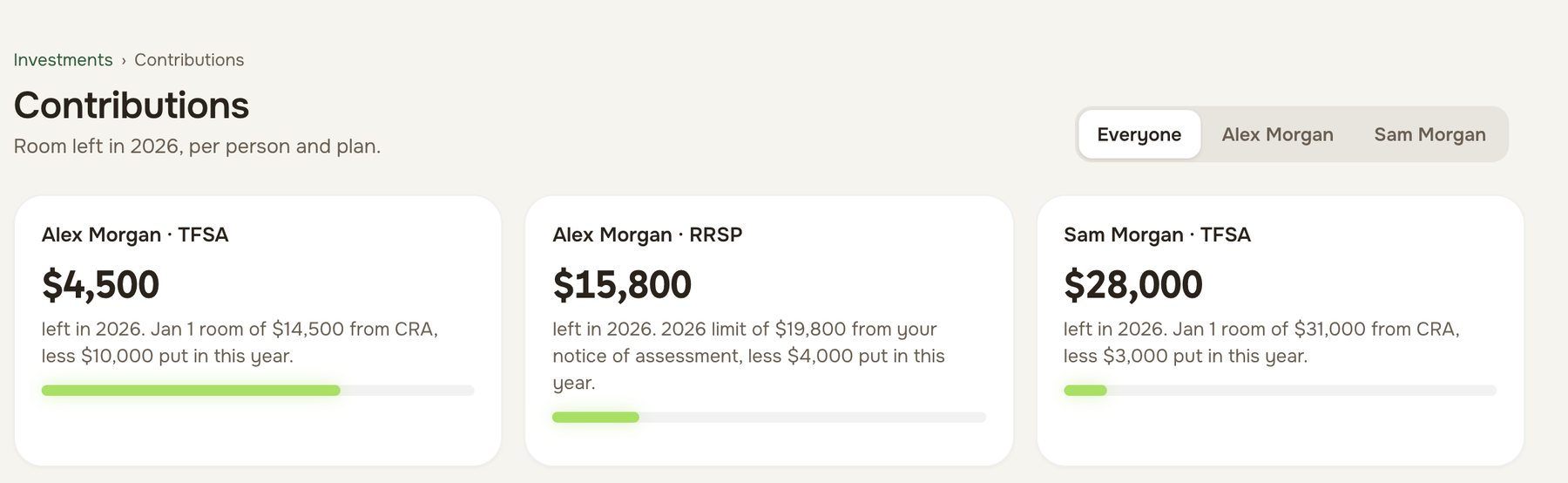
| TFSA, RRSP and FHSA room | Not stated | Each person’s room, starting from the CRA figure and kept right as deposits come in |
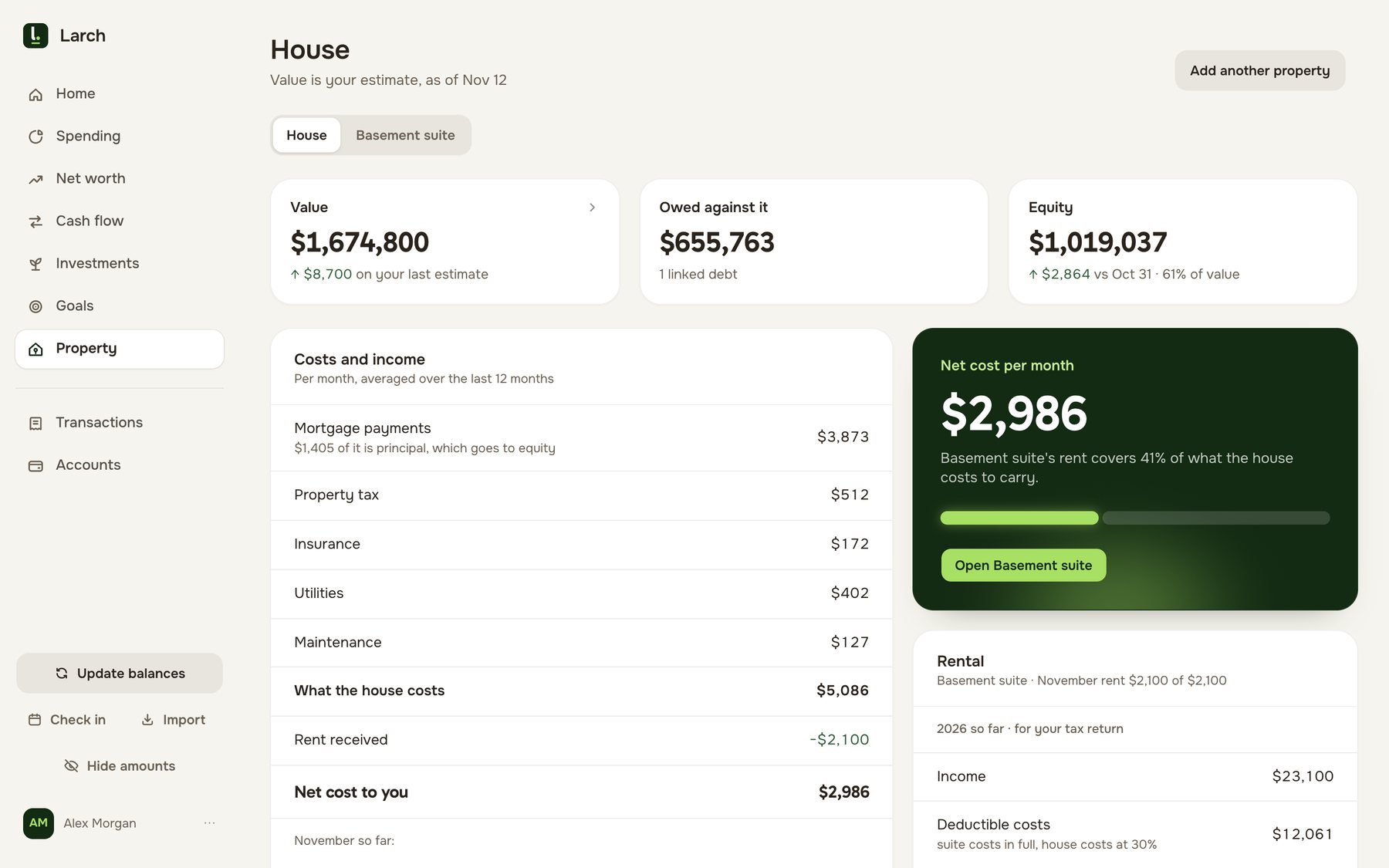
| Your home and mortgage | Real estate as a manually managed account; mortgage terms and renewal: not stated | Home value, mortgage terms, renewal date and equity, for one home or two |
| A rented suite | Not stated | Its own page by tax year: rent in, costs split, receipts filed, with form T776 in mind |
| Side business | Not stated, beyond inviting a business partner to a budget | An optional setting that keeps business money apart, with receipts read for you from a photo |
| Receipts | A file attached to a transaction, such as a photo or PDF | Photograph it and Larch reads the merchant, date and amount, for suite and business costs |
| Couples | An admin plus any number of collaborators, each with a login; everyone sees all accounts | Two equal partners, each with a login; every figure for the household or either of you |
| A monthly routine | Not stated | A ten-minute check-in that asks only what Larch can’t tell |
| AI | Not stated; categories come from Plaid’s, mapped to yours, and there’s a developer API | Connect your own Claude or ChatGPT to ask about your money, read-only |
| Apps | Web-first, with companion apps for iOS and Android | Runs in the browser on phone and desktop; no app-store app |
| Currency | Over 160 currencies, with totals in your primary currency | Canadian dollars |
| Where your data is stored | “We store Lunch Money’s data in the United States” | In Canada, in the Montréal region |
Lunch Money’s details are from its home page, pricing, Canada page, features and net worth tracker pages, its help pages on automatic imports, CSV and PDF importing, adding accounts, net worth, budgeting, recurring items, attachments, auto-categorization, multicurrency, collaborators and the mobile app, and its privacy policy. “Not stated” means Lunch Money’s pages don’t say. Larch’s are on How it works.
Where Lunch Money is stronger
- Transactions without a monthly step. When your bank connects through Plaid, Lunch Money brings transactions in when the bank sends them. With Larch, you download a statement for each account once a month.
- More than one currency. Lunch Money handles over 160 currencies in one budget, converting each transaction at that day’s rate. Larch works in Canadian dollars only.
- Phone apps. Lunch Money has companion apps for iOS and Android for adding and reviewing transactions. Larch runs in your phone’s browser.
- Room to tinker. Rules, tags, budget periods that fit your pay schedule and a developer API let you shape Lunch Money around how you already work.
- Bigger groups. Any number of collaborators can share one budget, and only the admin pays. Larch is built for a couple.
Where Larch is stronger
- Canadian accounts, by name. TFSA, RRSP and FHSA room for each person, from your CRA figures. Lunch Money’s pages don’t mention contribution room.
- The whole picture, not only the budget. Net worth for both of you and each of you, investment holdings by security, and your home, mortgage and renewal date beside your spending.
- Owners with a suite or a side business. A page for the suite by tax year, and business costs kept apart, with receipts read from a photo.
- No bank password, data in Canada. Larch has no connection to any bank, and your data is stored in Montréal. Lunch Money stores its data in the United States.
- Free while in beta. Lunch Money is $60 to $150 CAD a year, or $10 CAD a month.
When there are two of you
Lunch Money handles sharing generously: invite your partner as a collaborator and they get their own login, at no extra cost. Its help page says “Everyone on the shared budget account will have access to all connected bank accounts,” so the budget is one shared view. Lunch Money’s pages don’t say whether you can see net worth for each partner on their own.
Larch treats you as equal partners: invite your partner by link, and every page shows the household or either of you. That includes net worth and each person’s TFSA, RRSP and FHSA room, which is where couples most often lose track. Each partner’s statements come in the same way, whichever bank they’re from.
A worked example
Alex and Sam are an example couple with accounts at three institutions, a mortgage and a basement suite (example figures).
On Lunch Money’s monthly plan they pay 12 × $10 CAD = $120 a year; on the yearly plan, whatever they choose from $60 to $150 CAD. One subscription covers both of them. Their spending, recurring bills and net worth are covered, and their banks likely connect through Plaid. Their TFSA room, mortgage renewal and the suite’s rent and costs by tax year would live somewhere else, likely a spreadsheet.
With Larch they pay nothing during the beta. Once a month each of them downloads a statement per account and brings it in, which takes about ten minutes. The same household then shows their spending against their budgets, the bills calendar, net worth for both and each, each person’s room, the mortgage and the suite’s year.
Switching from Lunch Money to Larch
- Start with this month. Download each account’s latest statement from your banks as CSV or PDF, and bring them into Larch. There’s no Lunch Money file to convert.
- Set your budgets. Use the category amounts you had in Lunch Money as your starting budgets and targets.
- Add the rest. Your balances, your brokerage’s holdings report, your CRA room figures and your home, if you want the whole picture.
- Invite your partner by link.
For other Canadian apps, including net worth trackers and landlord apps, see Canadian money apps compared, or Larch and YNAB.