If you’re a Canadian looking at Quicken Simplifi, it’s a polished budgeting app from a US company with a long history, and it now lets Canadians link Canadian banks. Larch is built for Canadian households from the start. Simplifi links your accounts and looks ahead: a spending plan, projected balances for up to 12 months, savings goals and a retirement planner. Larch keeps the whole household’s money in one place: budgets and bills, net worth for both partners and each, contribution room, investments, your home and a rented suite or side business. It’s free while in beta. Every Simplifi fact below comes from Quicken’s own pages, checked on Nov 20, 2026.
The short answer
- Choose Simplifi if you want linked accounts that update nightly, a spending plan that sets bills and savings aside first, projected balances up to a year out, savings goals and a retirement planner, Quicken AI to answer questions, and apps for iOS and Android.
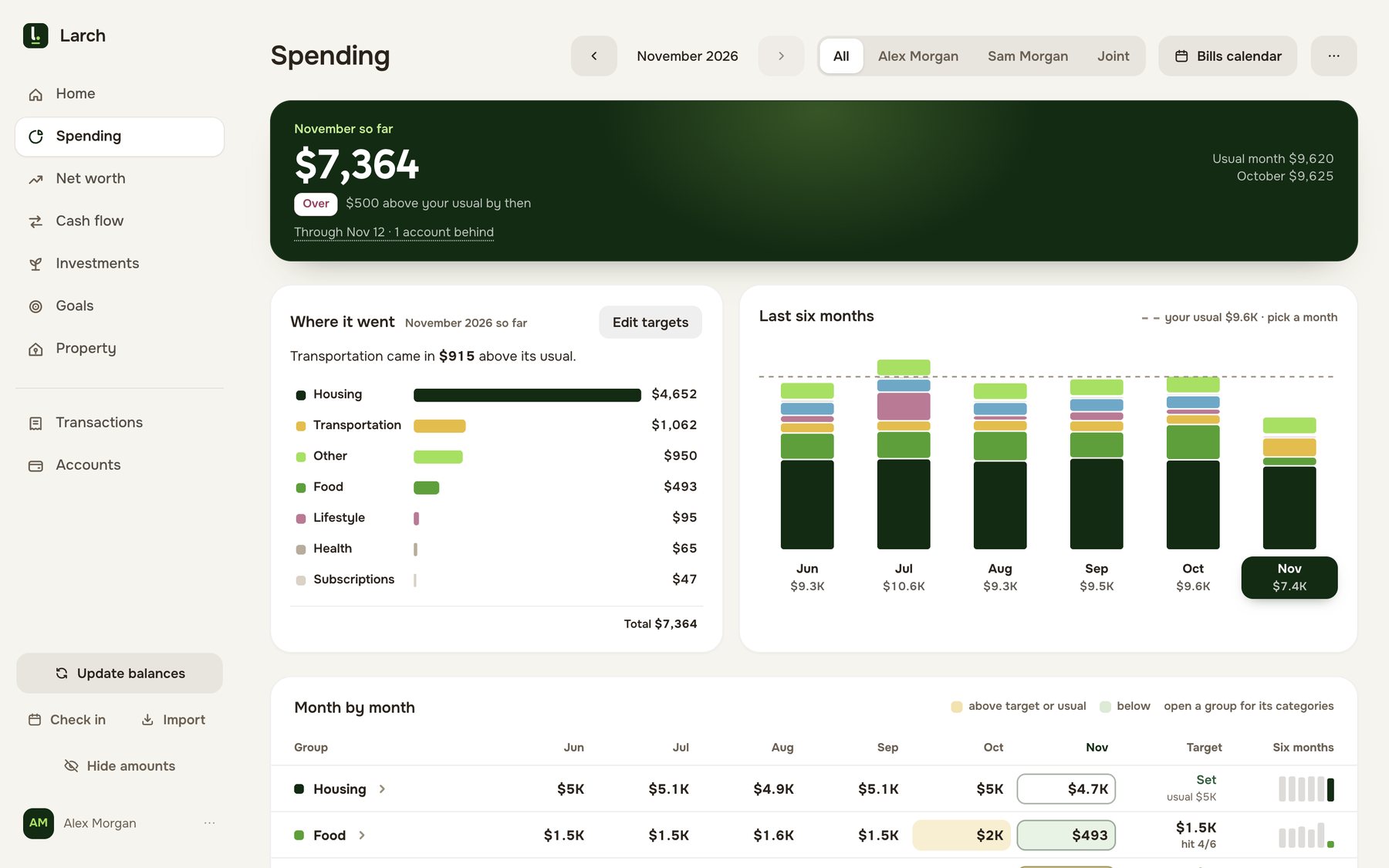
- Choose Larch if you’re a Canadian household that wants one picture of everything: what you spent, what you’re worth together and apart, how much TFSA, RRSP and FHSA room each of you has, what your home and mortgage are doing, and the books for a rented suite or side business. You bring a statement once a month; Larch never asks for your bank password.
What Simplifi costs in Canada
Quicken’s Simplifi page lists US$6.99 a month, “Billed annually”, with a first-year offer of US$3.99 a month for new members who order by Dec 8, 2026. The page lists prices in US dollars and doesn’t give a Canadian price. Simplifi’s help centre says “only annual plans are available”, renewals are charged at the full price, and there’s no free trial, only a 30-day money-back guarantee.
| Simplifi | Larch | |
|---|---|---|
| Yearly, regular | US$83.88, about CA$120.16 | Free while in beta |
| First year, offer to Dec 8, 2026 | US$47.88, about CA$68.59 | Free while in beta |
| Monthly billing | Not available | Free while in beta |
| Trial | None; 30-day money-back guarantee | No trial needed; no card |
| People on one plan | You plus one invited member, who needs no subscription | Your household: you and your partner, each with your own login |
Canadian-dollar figures use the Bank of Canada rate on Nov 20, 2026: US$1 = CA$1.4325. So 12 × US$6.99 = US$83.88, and US$83.88 × 1.4325 = CA$120.16. Your card issuer’s rate and fees will differ, and sales tax comes on top.
Feature by feature
| Simplifi | Larch | |
|---|---|---|
| How transactions get in | Linked accounts at US and Canadian institutions, updated nightly through an aggregation partner it doesn’t name; CSV import from its template; manual accounts | Statement files, CSV or PDF, from your banks and cards. Larch learns a new bank’s layout once |
| Your bank password | You enter your bank login; the aggregation partner stores it encrypted for updates | Never asked for |
| Budgeting | A Spending Plan: income less bills, subscriptions and savings, with what’s left to spend; Watchlists for categories | Category budgets and targets against your usual month, shown as “$446 of $350 · $96 over” |
| Bills | Recurring bills and subscriptions found for you, with reminders | A bills calendar of every bill, payday and card payment, marked paid, due or late, that you can add to Apple or Google Calendar |
| Looking ahead | Projected Cash Flow for each bank account, up to 12 months, from reminders and future-dated transactions | Not offered beyond scheduled payments |
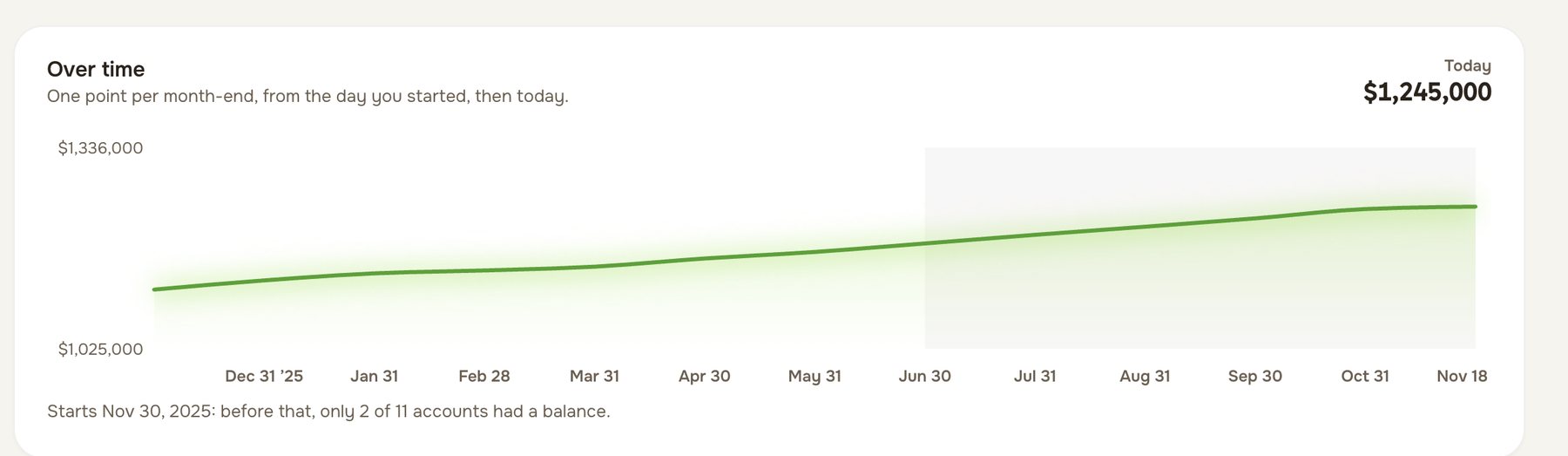
| Net worth | Assets and debts over time, with each account’s change and a debt-to-asset ratio | For the household or either of you, with an account-by-account, month-by-month table |
| Investments | Brokerage and retirement accounts, linked or tracked by hand | Holdings from your brokerage’s report, by security, with this year’s market change |
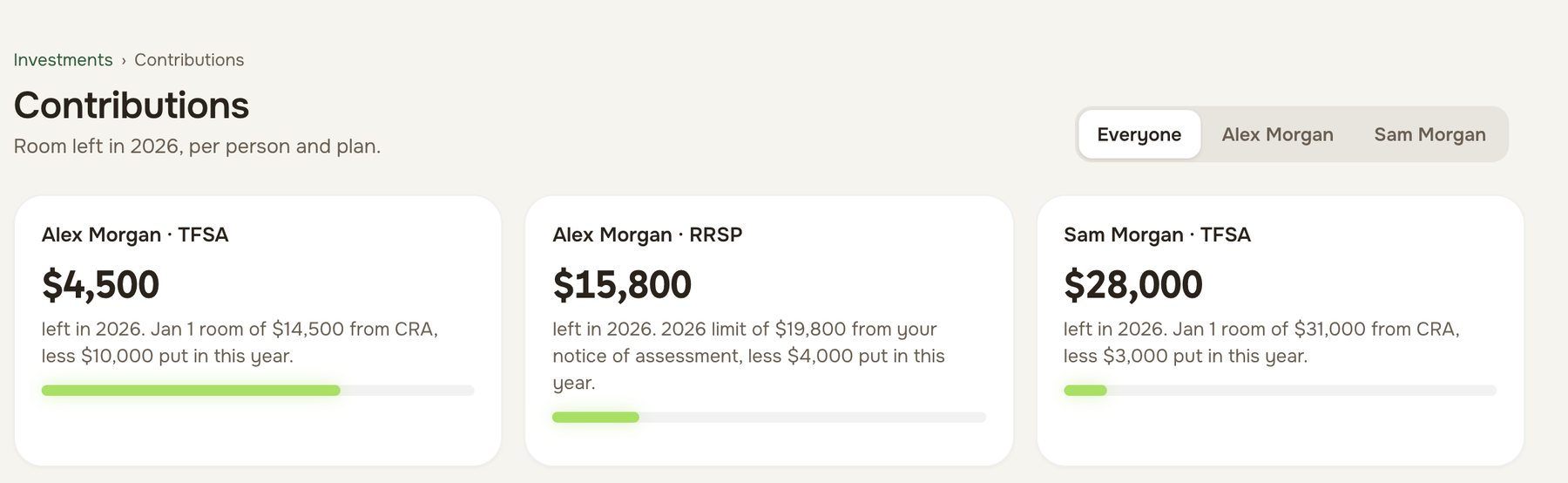
| TFSA, RRSP and FHSA room | Not stated; its supported account types list US accounts such as IRAs and 401(k)s | Each person’s room, starting from the CRA figure and kept right as deposits come in |
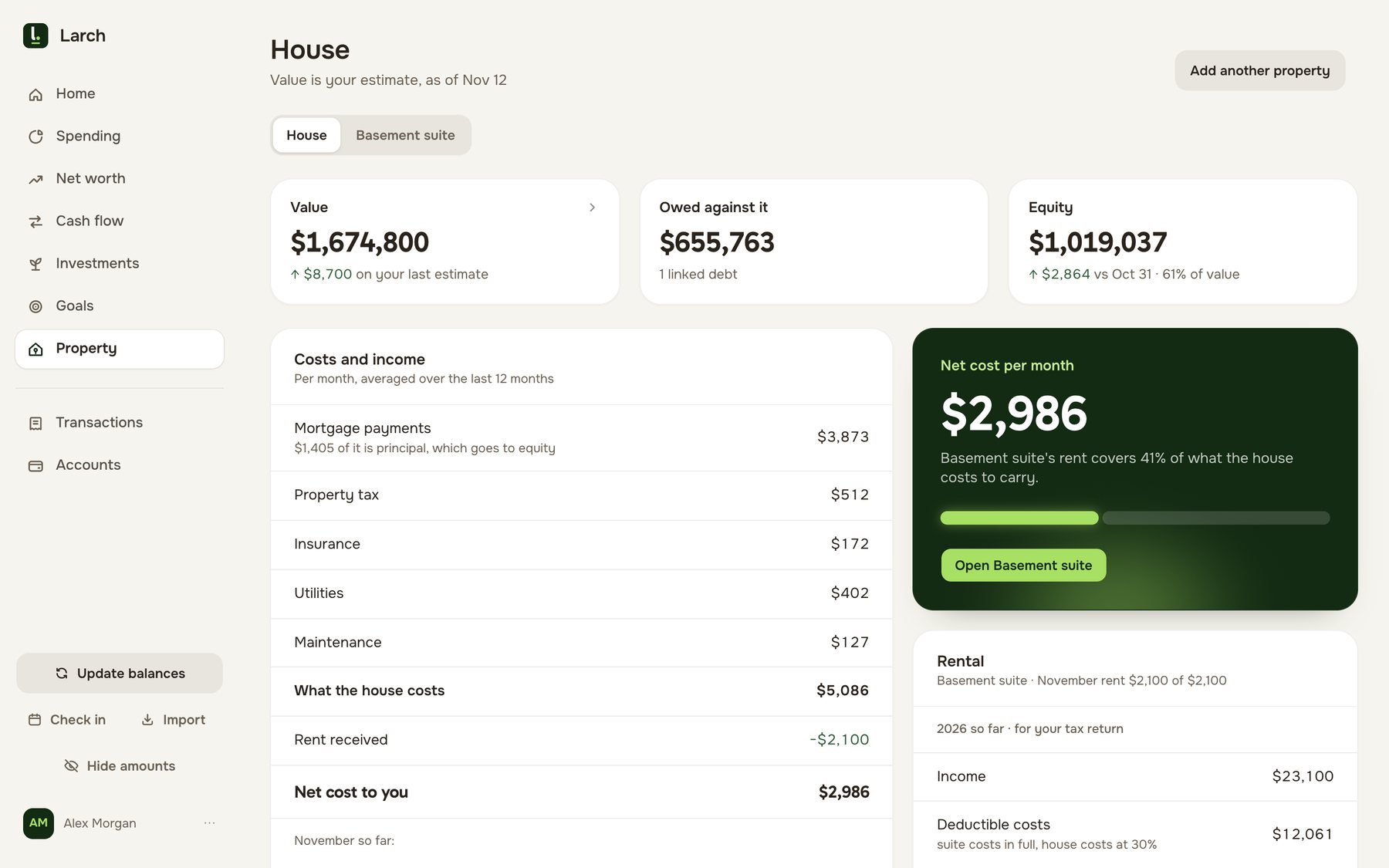
| Your home and mortgage | A real estate account valued by Zillow or by hand, and a mortgage account; renewal date: not stated | Home value, mortgage terms, renewal date and equity, for one home or two |
| A rented suite | Not in Simplifi; Quicken sells rental tracking in a separate product, Quicken Business & Personal | Its own page by tax year: rent in, costs split, receipts filed, with form T776 in mind |
| Side business | Not in Simplifi; business features are in Quicken Business & Personal | An optional setting that keeps business money apart, with receipts read for you from a photo |
| Couples | One shared space with one other member, who has their own Quicken ID | Two equal partners, each with a login; every figure for the household or either of you |
| A monthly routine | Not stated | A ten-minute check-in that asks only what Larch can’t tell |
| AI | Quicken AI chat inside the app | Connect your own Claude or ChatGPT to ask about your money, read-only |
| Apps | Web, plus iOS and Android apps | Runs in the browser on phone and desktop; no app-store app |
| Currency | US or Canadian dollars, one at a time | Canadian dollars |
| Where your data is stored | On “Quicken-hosted servers”; its Canadian privacy statement says some information may be stored outside your home country | In Canada, in the Montréal region |
Simplifi’s details are from Quicken’s Simplifi page, plans and pricing, Canadian product comparison, its Canadian launch release and Canadian privacy statement, and Simplifi’s help pages on subscriptions, currencies, bank connections, account types, sharing, net worth, projected cash flow and real estate values. “Not stated” means Quicken’s pages don’t say. Larch’s are on How it works.
Is Simplifi available in Canada?
Quicken’s own pages disagree. Simplifi’s help centre says it “can be used anywhere in the U.S. and Canada” and connects to US and Canadian accounts, and a 2024 Quicken release announced the app in the Canadian App Store and Google Play. Quicken’s Canadian product comparison still answers “Simplifi is for the U.S. only.” If you’re in Canada, check that your bank links before the 30-day refund window closes.
Where Simplifi is stronger
- Looking ahead. Projected Cash Flow shows each account’s balance up to 12 months out, and the Retirement Planner tests a bigger contribution or a different retirement age. Larch doesn’t project beyond scheduled payments.
- Transactions without a monthly step. Linked accounts update nightly. With Larch, you download a statement for each account once a month.
- A spending plan with savings set aside. Bills, subscriptions and savings goals come out of your income first, so what’s left to spend is clear.
- Phone apps and a long track record. Simplifi has apps for iOS and Android, and Quicken has made personal finance software for more than 40 years. Larch runs in your phone’s browser.
Where Larch is stronger
- Built for Canada. TFSA, RRSP and FHSA room for each person, from your CRA figures, and every amount in Canadian dollars. Simplifi’s account types are US ones, and Quicken’s Canadian page still lists Simplifi as US only.
- The whole household in one product. A suite by tax year and an optional side business sit beside your budget. With Quicken, rental and business tracking is a separate product.
- Two of you, each figure split. Every page for the household or either partner, including net worth and room.
- No bank password, data in Canada. Larch has no connection to any bank, and your data is stored in Montréal. Simplifi’s aggregation partner stores your bank login.
- Free while in beta. Simplifi is about CA$120.16 a year at the regular price, in US dollars, with no monthly option.
When there are two of you
Simplifi’s Spaces and Sharing lets you invite one other person to your space. They need their own Quicken ID but not their own subscription, and they join through the web app. Simplifi includes one shareable space, and its pages don’t say whether you can see net worth for each partner on their own.
Larch treats you as equal partners: invite your partner by link, and every page shows the household or either of you. That includes net worth and each person’s TFSA, RRSP and FHSA room, which is where couples most often lose track.
A worked example
Alex and Sam are an example couple with accounts at three institutions, a mortgage and a basement suite (example figures).
On Simplifi they’d pay US$83.88 a year at the regular price, about CA$120.16, or US$47.88 in the first year under the current offer. One subscription covers both of them. Their spending plan, bills, projected balances and net worth are covered, if their three institutions link. Their TFSA room, mortgage renewal and the suite’s rent and costs by tax year would live somewhere else, likely a spreadsheet or another Quicken product.
With Larch they pay nothing during the beta. Once a month each of them downloads a statement per account and brings it in, which takes about ten minutes. The same household then shows their spending against their budgets, the bills calendar, net worth for both and each, each person’s room, the mortgage and the suite’s year.
Switching from Simplifi to Larch
- Start with this month. Download each account’s latest statement from your banks as CSV or PDF, and bring them into Larch.
- Set your budgets. Use the planned spending from your Simplifi Spending Plan as your starting budgets and targets.
- Add the rest. Your balances, your brokerage’s holdings report, your CRA room figures and your home, if you want the whole picture.
- Invite your partner by link.
If you’re leaving Mint or another US app, see life after Mint. For other Canadian apps, see Canadian money apps compared, or Larch and YNAB.